Quick answer: Blue-and-white porcelain is made in eight broad steps. The clay is thrown on a wheel and trimmed thin once it is leather-hard. The design is painted straight onto the unfired body with a cobalt pigment and filled in with graded washes of the same pigment. The base is signed, the piece is coated in clear glaze, and it is fired once at high temperature, typically around 1,300 °C. The kiln turns the dull grey-black pigment blue and seals it under the glaze, which is why the pattern doesn’t wear off.
Every stage below comes from footage filmed at a Jingdezhen workshop we buy from and used with permission — real hands, a real wheel and a real kiln. The Chinese captions on screen name each step; we’ve added the English.
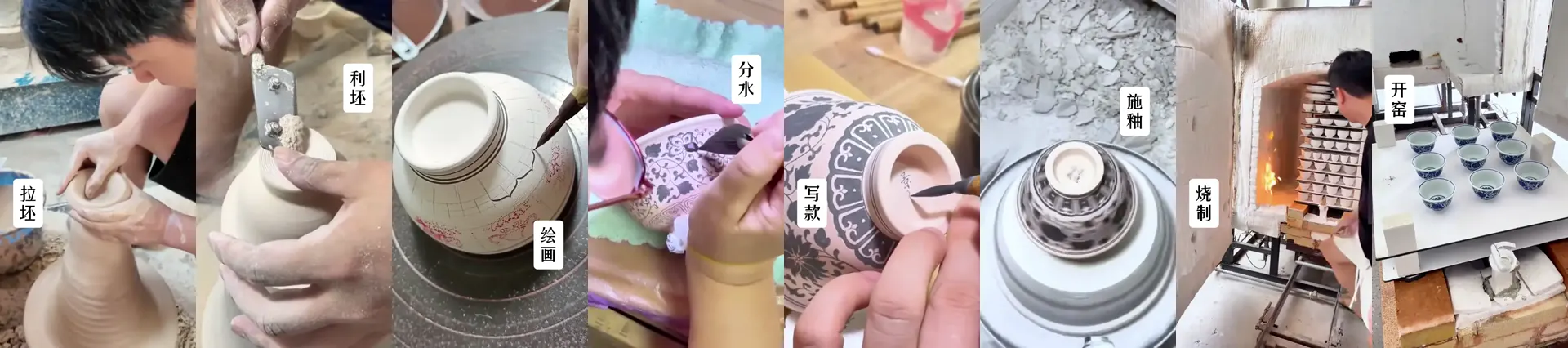
The whole process in 40 seconds, clay to kiln (no sound).
Throwing (拉坯)
A lump of porcelain clay is centred on the wheel and pulled up by hand into a rough cup, bowl or vase. Jingdezhen porcelain is traditionally made from two local materials: kaolin, which keeps the body standing at high temperature, and porcelain stone (cishi), which melts slightly in the kiln and gives the body its whiteness and translucency. At this stage the walls are still thick and soft. The thrower only needs the shape.
Trimming (利坯)
When the piece has dried to “leather-hard”, it goes back on the wheel and the walls and foot ring are shaved thin with a steel blade. Trimming is where a good cup gets its lightness, because it removes most of the clay the thrower left behind. In the clip you can see the blade peeling clay away as the wheel turns. Trim too far and you cut a hole; stop too early and the cup stays heavy.
Drawing the design (绘画)
The design is painted straight onto the unfired, unglazed clay. The surface soaks up pigment instantly, so a stroke can’t be taken back. The outlines are drawn in qinghua liao, a cobalt-bearing pigment that looks grey-black before firing — nothing like the blue it will become. In the clip the painter draws fine outlines on an upturned bowl sitting on the wheel.
Filling the colour: fen shui (分水)
Fen shui (literally “dividing the water”) is the technique that gives Jingdezhen blue-and-white its depth. The painter loads a large, soft brush with pigment diluted to different strengths and lets it flood the spaces inside the outlines, where it settles into smooth, graded tones. The shades of blue come from one pigment; the only thing that changes is the water. It is also one of the clearest signs of hand-painting, because a printed pattern can’t reproduce the soft, pooled edges that fen shui leaves behind.
Signing the base (写款)
The mark on the foot is written by hand with a fine brush. In the clip it is brushed inside the foot ring of a jar that has already been painted. Marks are often written in the style of a historic reign mark, sometimes as a workshop or studio name. They are tradition, not a date stamp: an old-style mark on a new piece says nothing about its age, and an honest seller describes new work as new.
Glazing (施釉)
The piece is coated with a clear glaze by dipping, pouring or spraying, depending on its shape. The glaze covers the painting completely. Unfired glaze is chalky and opaque, so at this point the design disappears under a pale coat.
Firing (烧制)
Racks of glazed pieces go into the kiln for a single high firing, typically around 1,300 °C. Three things happen at once: the porcelain body vitrifies and shrinks, the glaze melts into a glassy skin, and the cobalt turns blue. Because the colour ends up locked between body and glaze, this is called underglaze decoration, and it is why blue-and-white survives centuries of use.
Opening the kiln (开窑)
Once it has cooled, the kiln is opened and every piece is picked up and checked by hand. Warping, glaze bubbles, iron specks and lines that blurred where the pigment ran are all decided inside the kiln, and not every piece makes the cut. In the last frames of the clip, a finished cup is held up to the camera: crisp blue under a glossy glaze.
How to tell hand-painted blue-and-white from printed decoration
- Look for pooling. Fen shui leaves soft, slightly darker edges where the pigment settled. Decals and screen prints tend to show flat, even colour, and under a magnifying glass sometimes a fine pattern of printed dots.
- Compare repeated motifs. Hand-painted flowers on the same piece are similar but never identical. Printed ones match exactly.
- Feel the surface. Underglaze painting sits under one smooth, continuous glaze. Overglaze enamels and decals can often be felt as a slight edge — see our guide to overglaze vs underglaze porcelain.
- Expect variation. Two hand-painted cups of the same design will differ in line weight and tone. The variation is proof of the hand, not a flaw.
What this means when you buy blue-and-white porcelain online
Because every piece comes out of the kiln a little different, product images can’t show the exact piece you will receive. That is why we photograph the exact piece for your order before it is wrapped; ask when you order and we will email you the photos before dispatch. Where we have verified how a piece was made, its product page says so, and we only call something hand-painted when it is.
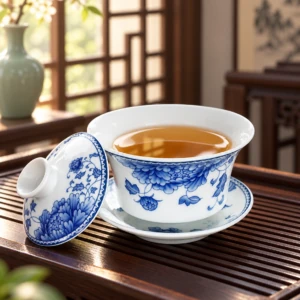
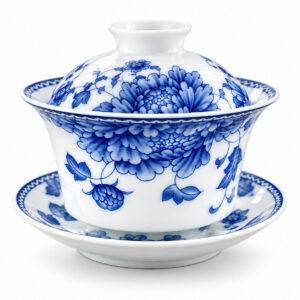
Classic Blue-and-White Lotus Gaiwan
Three-piece gaiwan (lid, bowl and saucer) with a broad lotus pattern. US$28, available to order, photographed before dispatch and shipped tracked from Jingdezhen within 1–3 business days.
More blue-and-white in our teaware collection, including a 14-piece portable gongfu set. For the shelf, browse porcelain décor. Orders over $59 ship free and tracked, and anything that arrives broken is replaced or refunded.
Frequently asked questions
Why is blue-and-white porcelain blue?
The pigment contains cobalt. It looks grey-black when it is painted on raw clay and only turns blue during the high-temperature firing, under the glaze.
Is all blue-and-white porcelain hand-painted?
No. A lot of the blue-and-white sold today is decorated with printed transfers or stamps. That’s fine as long as it’s described honestly. Hand-painted pieces show brush variation and the pooled tones of fen shui.
Will the blue pattern wear off?
Not with normal use. Underglaze decoration is sealed beneath the glaze, which protects it from cutlery, tea stains and washing. Gold rims and overglaze enamels are different, because they sit on top of the glaze.
How should I wash blue-and-white porcelain?
We recommend hand washing, which is gentler on thin rims and lids. Anything with gold, overglaze colours or wooden parts should stay out of the dishwasher. Each product page lists the care notes for that piece. Our porcelain cup care guide covers the rest.
What makes Jingdezhen porcelain different?
Local clay and more than a thousand years of kiln work concentrated in one city. We cover it in what makes Jingdezhen porcelain special.