There’s a Chinese phrase for a whole category of modern teaware: lanren chaju — “lazy person’s tea gear”. It sounds like an insult and is actually a design philosophy. Traditional gongfu brewing asks for a free hand, good wrist control and full attention; lazy tea gear redesigns the tools so that the tea still gets short, precise infusions while you get to keep reading your email. Done well, nothing about the tea is compromised. Here’s how the main mechanisms work and who each one genuinely helps.
The tipping-stand teapot: pouring without lifting
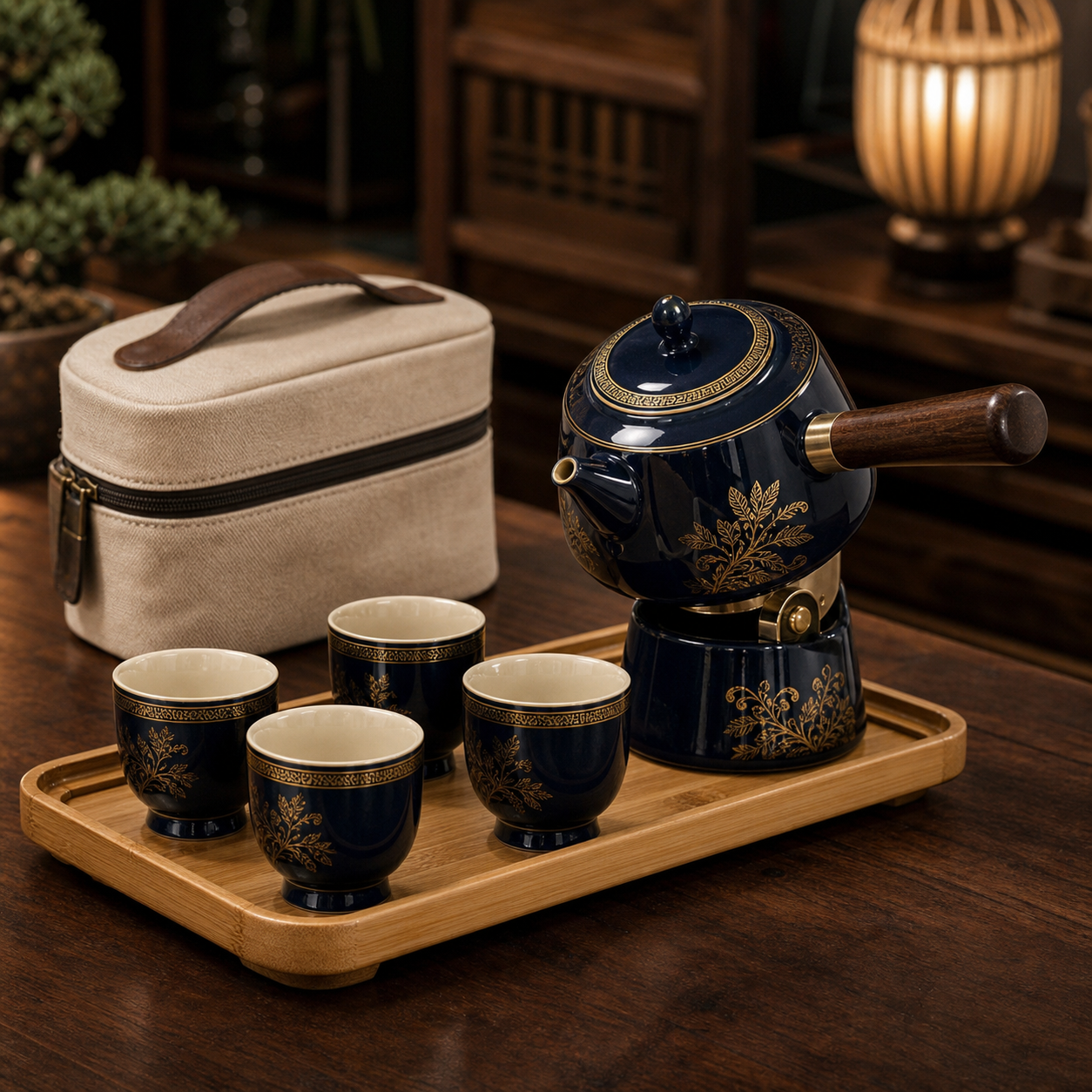
The most elegant of the lazy mechanisms is the self-pouring or rotating teapot: the pot sits in a cradle stand, and instead of picking it up, you tip it forward on its pivot. The spout dips, the pot decants into the fair cup below, and it rocks back upright when you let go. Our self-pouring side-handle set works exactly this way — deep navy glaze, gold botanical sprays, and a stand that does the wrist work.
Why bother? Because a full teapot of just-boiled water is the single most drop-prone, burn-prone object on a tea table. If your grip is unreliable — arthritis, tremor, or simply a desk crowded with electronics — the tipping stand removes the risk without removing the ritual. You still control timing, dose and water; you just stop hoisting hot ceramic over your keyboard.
The side handle: an old solution that never left
Side-handle pots (ceba hu in China; the Japanese kyusu is the famous cousin) put the handle at ninety degrees to the spout instead of opposite it. The physics is simple: your wrist rotates in its natural direction to pour, and the pot’s weight stays over your hand instead of levering away from it. One-handed pouring becomes stable even when the pot is full. Ours pairs a solid wood handle with a brass collar, so the grip stays cool while the pot stays hot.
If you’ve only ever poured from a back-handle English-style teapot, the first side-handle pour feels odd for about a day, and then the old way feels wrong forever.
Semi-automatic brewers: the leaves stay put
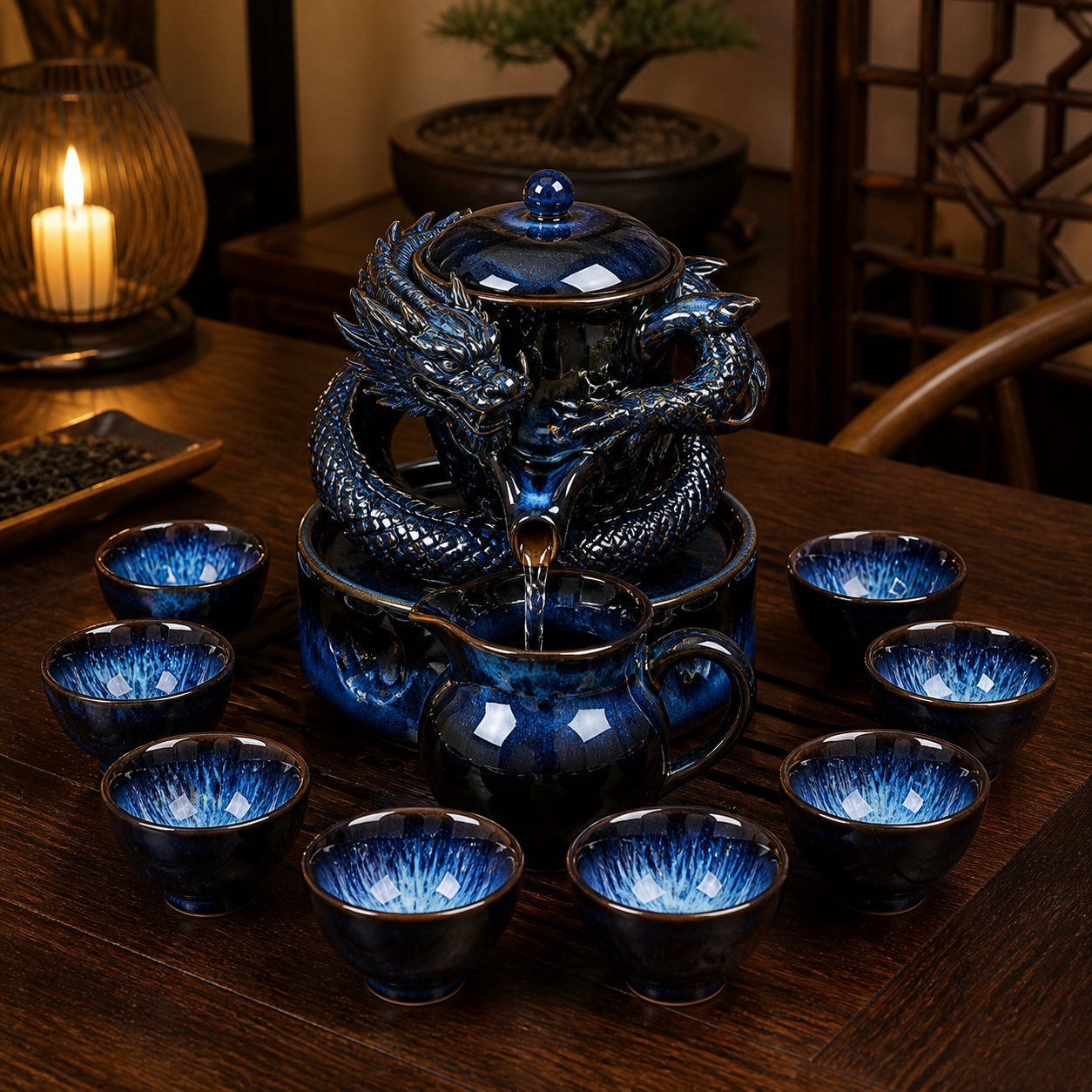
The other lazy lineage separates steeping from serving inside one object. In a semi-automatic set, the brewing chamber sits above and decants through its own spout into the fair cup or bowl below — you pour water in, wait, and release; the leaves never travel with the tea. Our cobalt dragon flambé set is built this way: the sculpted pot decants down into the fair cup on its own, which means consistent strength with zero pouring technique. (The same set stars in our guide to kiln-change glazes — it earns its keep twice.)
Semi-automatic sets are the best answer for households where several people brew but only one of them is “the tea person”. Anyone can operate it; the tea comes out the same.
The travel gaiwan: minimalism as convenience
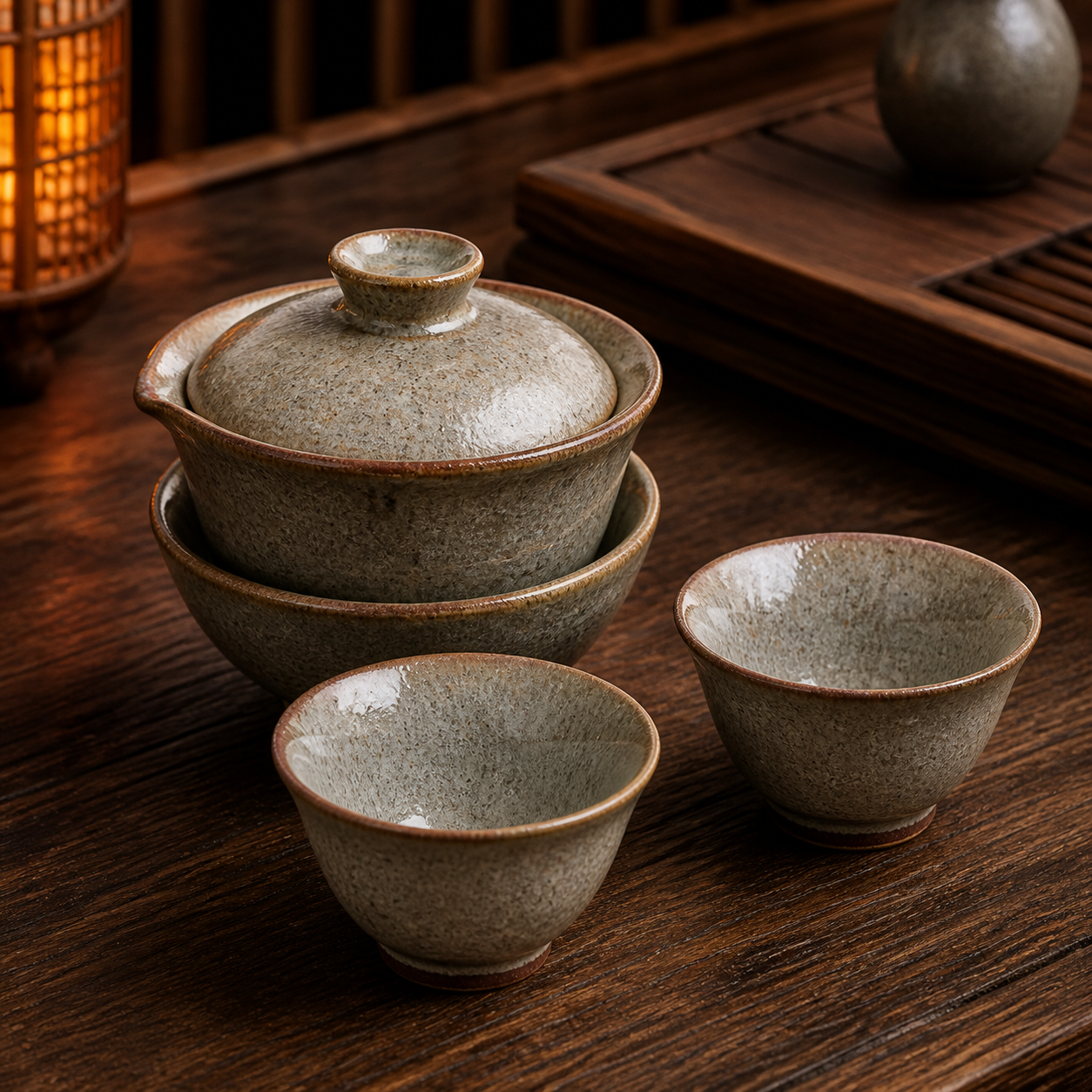
Lazy gear isn’t always mechanical. Sometimes it’s just fewer, tougher, nesting pieces. A travel gaiwan set — ours is three pieces in a granite-speckled glaze, the lidded bowl nesting with two wide cups — is gongfu brewing reduced to what fits in a coat pocket. The gaiwan has a small pour spout on the rim, so even the lid-control technique gets easier: less angle to manage, cleaner stream, no drips down the side.
For desks, hotel rooms and train windowsills, this beats any mechanism. There’s simply less to go wrong. If you’re still deciding whether a gaiwan suits you at all, start with Gaiwan vs Ceramic Mug.
Does easier mean worse tea?
No — and it’s worth being precise about why. What makes gongfu-style tea good is short steeps, right water temperature, decanting fully so leaves don’t stew, and even strength across cups. Every mechanism above preserves those variables; they only change whose muscles execute them. A tipping stand decants just as completely as a lifted pot. A semi-automatic chamber separates leaves from liquor more reliably than a rushed manual pour.
What you do give up is some tactile feedback — the weight of the pot telling you how much water is left, the lid gap you adjust by feel. Purists miss it. If you’re brewing six rounds for guests while also being the host, you’ll trade that feedback for a free hand and never look back. And a full cased set with every manual piece is always there when you want the complete ceremony — see What’s Inside a 14-Piece Gongfu Tea Set.
Care notes for moving parts
These sets are ceramic first, mechanism second, so care is mostly ordinary: hand-wash, no abrasives, dry bamboo and wood parts promptly. Two specifics: keep the pivot area of a tipping stand dry and free of tea residue so it rocks smoothly, and don’t force a wooden side handle that’s loosened — tighten the collar fitting instead. Gold-tone decoration means no microwave, ever.
Quick answers
Are self-pouring teapots gimmicks? The mechanism is old physics — a pivot and a spout — not electronics. There’s nothing to break in the way a gadget breaks. Judge the set by its ceramic quality; the stand is just good manners for your wrist.
Which is best for a complete beginner? The semi-automatic style, honestly. It makes the strength-consistency part automatic while you learn leaf dose and timing.
Can I use these for any tea? Yes — oolong, puer, black, white and green all work. The mechanism doesn’t care; only water temperature and timing change per tea.
The three sets from this guide are below, each with full piece lists and honest notes on what’s hand-finished versus fired-in-the-kiln.