Quick answer: Chinese baijiu cups are intentionally small ceramic or porcelain cups used for strong grain spirits and repeated banquet toasts. Choose by stated capacity, rim comfort and the number of cups in the set—not by photographs alone.
Celadon Ceramic Baijiu Wine Set with Tray
Lidded ewer, 6 stemmed cups and round tray. US$89, in stock, photographed before dispatch and shipped tracked from Jingdezhen within 1–3 business days.
Every culture that toasts has furniture for the ritual. Champagne gets flutes; sake gets the tokkuri and ochoko; and Chinese banquet spirits — baijiu above all — get the wine ewer and small stemmed cups, set out on a shared tray. If you’ve only ever seen baijiu poured from the bottle into shot glasses, a proper ceramic wine set is the difference between drinking and hosting. Here’s what the pieces do, why celadon is the classic glaze for the job, and how to judge a set as a gift.
What is a baijiu cup, and what comes in a Chinese wine set?
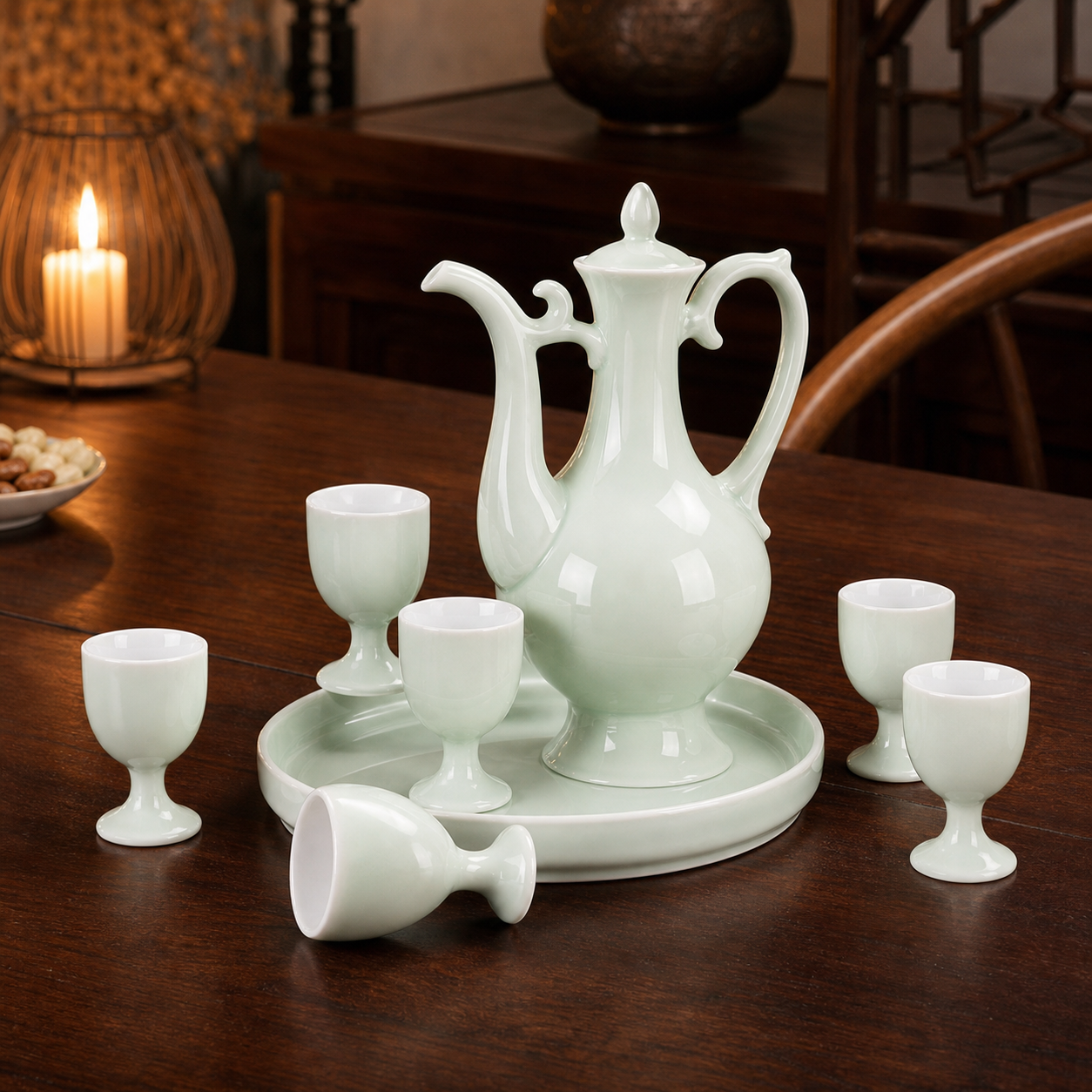
The heart of the set is the ewer (jiuhu) — a tall, lidded pouring vessel with a slim goose-neck spout. Its job is portion and grace: baijiu is strong (often 40–60% ABV), so it’s poured in small, deliberate streams, and a narrow spout gives you a thin, controlled pour that never glugs. The lid keeps aroma in between rounds.
The stemmed cups hold far less than they appear to — a proper baijiu cup is closer to a large thimble than a shot glass. That size is social engineering: toasts happen many times across a dinner, person by person, and small cups let everyone participate in every round without anyone leaving on a stretcher. The stems keep hands off the bowl, which matters when spirits are served gently warmed.
The tray makes the set a set. It carries everything to the table at once, catches drips, and — during toasts — gives the host a stage to refill from. Our celadon set runs eight pieces: the lidded ewer, six stemmed cups, and the round tray.
Why celadon, specifically
Celadon — the pale jade-green glaze family perfected in Song dynasty kilns like Longquan — has been the aristocrat of Chinese table ceramics for a thousand years. Poets compared it to “borrowed jade”; emperors reserved the best of it. Two practical reasons it still owns the wine-set category:
First, the color flatters what’s poured. Baijiu, plum wine and sake are all pale liquids; against a soft jade-green interior they read silvery and clean rather than invisible (white) or murky (dark glazes). Second, celadon’s watery, semi-translucent depth looks ceremonial without ornament — no gilding, no painting, just glaze doing all the work. It signals formality the way linen does: quietly.
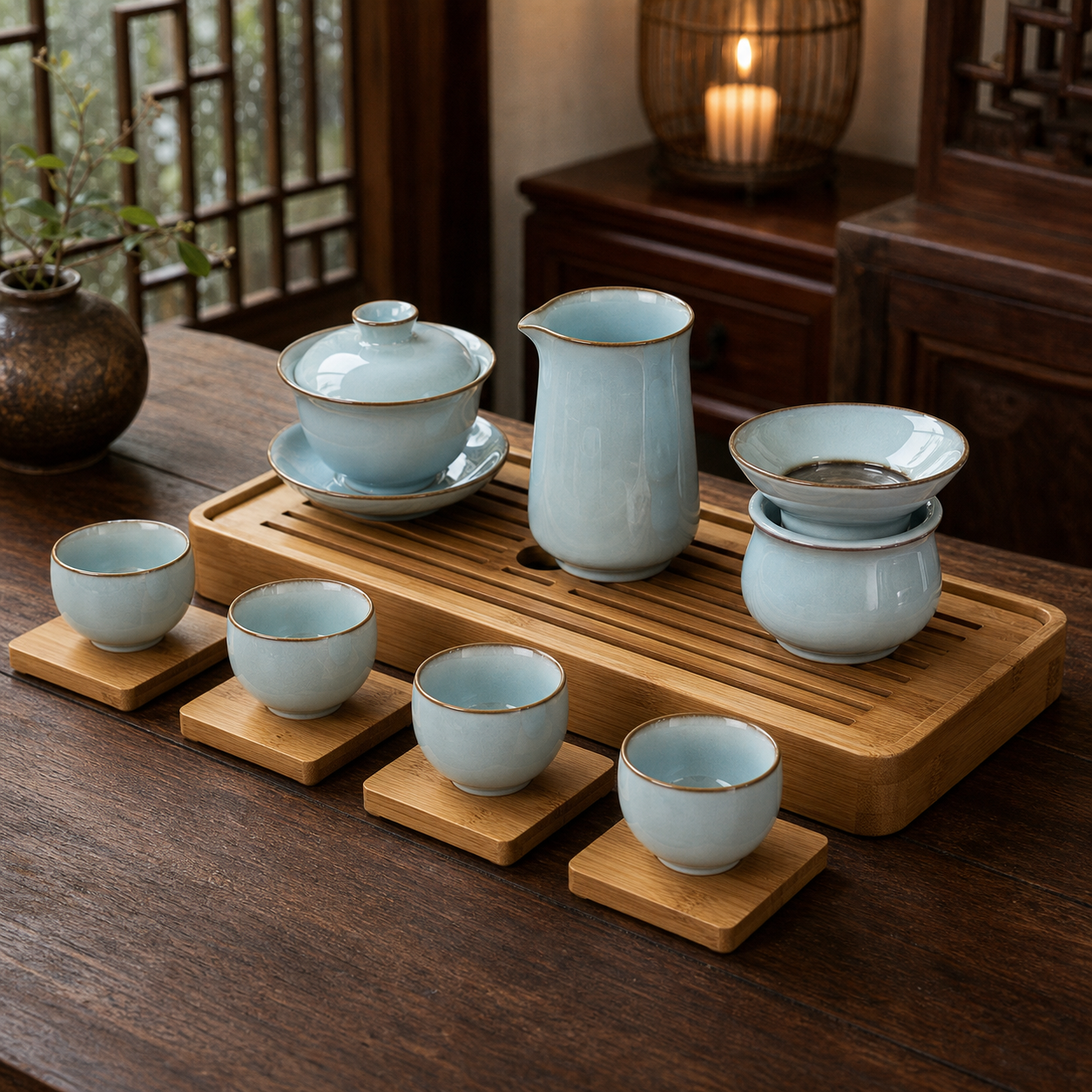
If your table already leans blue-and-white, celadon shares the same porcelain gravity and mixes in without argument — our sky-blue celadon gongfu set is the tea-side sibling of the same palette, and the two sets side by side furnish an entire hosting shelf.
Not just baijiu
Honest scope note: this is a small-pour spirits set, and it doesn’t care about nationality. Sake works beautifully — the ewer is, functionally, a lidded tokkuri with a spout. Plum wine, umeshu on ice (in the cups, not the ewer), soju, even a dessert sherry all sit correctly in stemmed cups this size. What it’s not for: wine-glass volumes, beer, or anything carbonated — the pours are wrong and the spout will foam.
Warming is traditional for some spirits: stand the filled ewer (lid off) in a bowl of hot — not boiling — water for a few minutes. Never put gold-trimmed or any ceramic ewer over direct flame, and skip the microwave entirely.
Judging a set as a gift
Wine sets are one of the most-gifted objects in Chinese households — weddings, housewarmings, a parent’s birthday, business thanks — because the object itself toasts the recipient. Three things to check, whichever set you buy:
Cup count matters culturally. Six cups is the standard and the safe gift: it hosts a full table and the number reads as smooth and auspicious. The pour test. A good goose-neck spout cuts off cleanly without dribbling down the ewer’s belly; that’s craftsmanship you can ask about. The glaze’s evenness. Celadon shows its quality in how evenly the green pools — small variation is the handmade signature, blotches are not.
For pairing logic and more occasions, our Blue and White Porcelain Gift Ideas and Tea Lover Gift Set Ideas guides cover the adjacent shelves.
Care, briefly
Celadon is fully glazed and unfussy: hand-wash warm, soft sponge, no abrasives. Rinse the ewer promptly after spirits — sugar-heavy liqueurs left overnight are the only real staining risk. Dry the inside of the lid before storing. Everything else in our ceramic care guide applies unchanged.
Quick answers
Can I actually use it, or is it display-ware? Use it. It’s glazed functional porcelain, not an antique. The ceremonial look is free; the pouring is the product.
How big are the cups? Small by design — banquet toasting size. If you want a single generous pour rather than many small ones, this isn’t the right tool; that’s what the stemless teacup shelf is for.
Is celadon dishwasher-safe? We’d hand-wash. The set survives a dishwasher physically, but stemmed cups and slim spouts are exactly the shapes racks like to chip.
The celadon wine set — and the matching-palette celadon tea set — are below with full piece lists.
What size is a baijiu cup?
There is no single universal baijiu cup capacity. Chinese baijiu cups are intentionally small because the spirit is strong and banquet toasts are poured in short servings, but actual capacity varies by maker and shape. Do not estimate volume from a product photograph: check the listing for cup dimensions or capacity, and treat a missing measurement as a question to ask before buying.
A narrow rim emphasizes a controlled sip; a wider cup exposes more aroma. Stemmed cups are easy to lift from a shared tray, while footed or straight-sided cups may feel steadier at home. None of these shapes changes the alcohol strength, so serving size should follow the drink and the guest rather than the “ganbei” toast alone.
What should a Chinese baijiu cup set include?
| Piece | Purpose | Check before buying |
|---|---|---|
| Ewer or wine pot | Controls the pour and keeps the table presentation together | Lid fit, handle clearance and whether the spout drips |
| Small baijiu cups | Portions strong spirits for individual guests | Number of cups, rim comfort and stated capacity |
| Tray | Moves and presents the set as one group | Whether every included piece fits without crowding |
A current celadon baijiu set to compare
The Celadon Ceramic Baijiu Wine Set with Tray includes a lidded ewer, round tray and six stemmed cups. Its green celadon glaze is quieter than blue-and-white decoration, making the form and shared serving ritual the focus. Check the live product page for current price, stock and exact listing details before ordering.
For a gift, count the likely drinkers first, then check how the set will be stored. A six-cup set makes sense for a small dinner group; a solitary decorative ewer does not replace a usable cup set. Wash glazed ceramic by hand with a soft sponge, dry the foot rings before storage and avoid knocking thin rims together.
Serving baijiu without forcing the toast
- Set the cups on the tray before filling them.
- Pour modestly and offer water and food alongside the spirit.
- Explain the glaze or vessel only if guests are interested; the set should support hospitality, not turn it into a test.
- Never pressure a guest to empty a cup. A toast can be acknowledged with a small sip.
Browse Jingdezhen porcelain and teaware →